
If the name Bartek Ziemski does not immediately ring a bell, that is probably exactly how he wants it. In an era where many high altitude climbers build personal brands alongside expeditions, the Polish ski mountaineer has largely stayed out of the spotlight. No constant social media updates. No major sponsor machine. No carefully curated online image. Just serious mountain objectives and the skill to pull them off.
In a climbing season increasingly dominated by commercial teams, traffic jams, drones and social media noise, Polish ski mountaineer Bartek Ziemski has quietly completed one of the most remarkable Himalayan ski achievements in recent memory.

Ziemski climbed and skied both Lhotse and Mount Everest without supplemental oxygen, descending all the way back to Base Camp. No bottled oxygen. No major sponsor campaign. No media circus. Just high level mountain skill operating in one of the harshest environments on earth.
The 37 year old skier from Poland reportedly lives a low key life, avoids social media attention and approaches the mountains more as personal adventure than commercial project. That alone makes this story stand out in modern Everest culture.
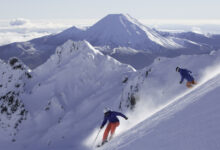
His first major descent came on Lhotse, the world’s fourth highest mountain. The route itself is considered one of the hardest ski descents in high altitude mountaineering. Previous ski descents on the face have become legendary within the sport, but Ziemski pushed the line further by reportedly skiing continuously from the summit back to Everest Base Camp without supplemental oxygen.
Conditions were far from straightforward. Wind packed snow near the summit quickly gave way to exposed rock and hard ice lower on the face. The terrain funnels into steep couloirs above massive exposure where mistakes are rarely survivable.
The route also cuts through mountaineering history. The Lhotse Face became internationally famous after Japanese skier Yuichiro Miura’s dramatic Everest ski descent in 1970, later captured in the Academy Award winning documentary The Man Who Skied Down Everest.

After completing Lhotse, Ziemski then turned his attention to Everest itself.
Just days later, he climbed Mount Everest and again skied back down to Base Camp without bottled oxygen, becoming one of only a tiny number of athletes to achieve such a descent. According to reports, he also became the first person to complete both Everest and Lhotse ski descents without supplemental oxygen in the same season.
What makes the story compelling is not just the physical feat. It is the contrast with modern Everest culture.
Everest has increasingly become a place of logistics, queues and guided summit production. Ziemski himself reportedly commented that the mountain felt more like a city compared to the remoteness he experienced on other 8000 metre peaks.

Yet despite the crowds and commercial machinery surrounding the mountain, genuine edge of human performance still occasionally cuts through the noise.
This was one of those moments.