
Few people would disagree that lift operators should be focused on the job rather than their phones.
Chairlifts move thousands of skiers every day and even a brief lapse in concentration has the potential to create serious consequences. Safety around lifts has always been non negotiable, which is why a recent campaign by California’s Donner Ski Ranch initially sounded like a sensible reminder. Instead, it has become one of the most talked about controversies of the North American ski season.
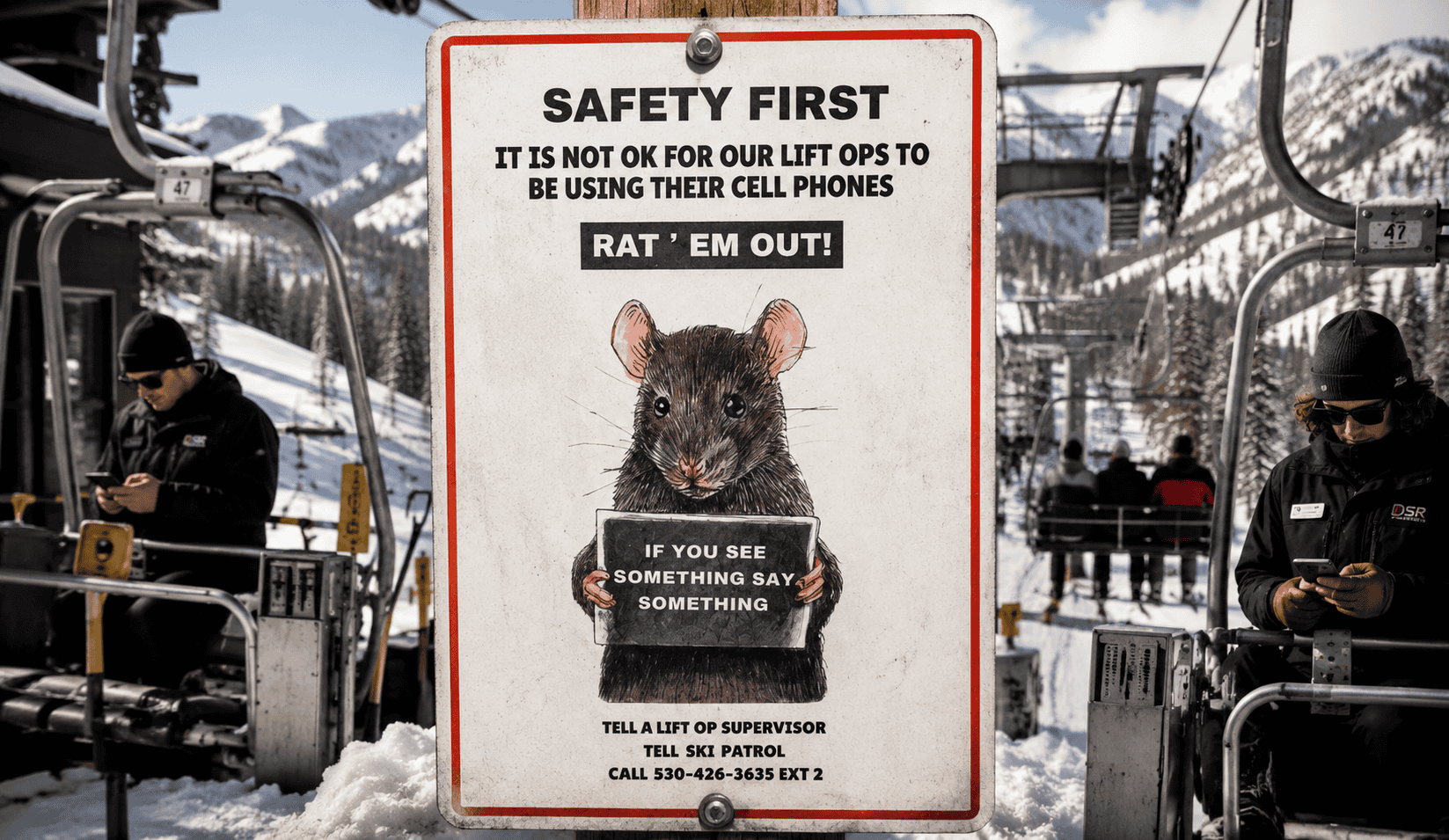
The independent Lake Tahoe resort has installed signs at the loading and unloading areas of every chairlift asking guests to report lift attendants seen using mobile phones while on duty. The signs leave little room for interpretation. Alongside a cartoon rat is a message encouraging skiers and snowboarders to tell a supervisor if they witness a lift operator using a cellphone while working.

The objective is understandable. Nobody wants the person responsible for loading chairs, slowing lifts for beginners or responding to incidents distracted by text messages or social media. Modern chairlifts rely on attentive operators, and resorts spend enormous amounts of time and money developing procedures designed to minimise risk. Where Donner Ski Ranch found itself in trouble was not the safety message itself, but the decision to involve paying guests in enforcing it.

Reaction across social media was immediate and overwhelmingly critical. Many skiers argued the resort had blurred the line between promoting safety and asking customers to supervise staff. The criticism centred on a simple question. If employees are regularly using their phones while working, shouldn’t that be an issue for supervisors rather than visitors who have paid for a day’s skiing?
The discussion quickly expanded beyond mobile phones. Many commenters argued that successful safety cultures are built through good leadership, proper training and clear accountability, not by encouraging guests to report frontline staff. Others suggested the campaign risked damaging morale among lift crews who already work long days in harsh alpine conditions while facing the high cost of living that has become common in many North American mountain towns.
Rather than softening its position, Donner Ski Ranch defended the campaign and responded directly to many critics online.
Resort representatives rejected suggestions that wages or workplace culture were part of the problem and maintained the signs were simply another tool to reinforce safety standards. Those responses only added fuel to the debate, turning what may have been intended as a straightforward safety reminder into a much broader discussion about management, staff relationships and the realities of operating a modern ski area.
There is an irony in the whole episode. Donner Ski Ranch has long been respected as one of Lake Tahoe’s fiercely independent resorts, earning a loyal following by doing things differently from the large corporate ski companies that dominate much of the North American market. Independent hills are often celebrated for their personality and willingness to challenge convention, but that independence also means decisions are scrutinised just as heavily. In this case, many skiers felt the resort had crossed the line between promoting safety and shifting responsibility.

The controversy also highlights a challenge facing every ski resort. Maintaining safety standards is becoming increasingly difficult as operators compete for seasonal staff in expensive mountain communities where affordable housing is scarce and wages often struggle to keep pace with living costs. Resorts need experienced lift operators, but they also need engaged employees who feel respected and valued. Publicly asking guests to report them may achieve greater vigilance, but it also risks creating an environment built on mistrust rather than teamwork.
The irony is that almost everyone involved in the debate agrees on the most important point. Lift operators should not be using mobile phones while they are responsible for moving chairlifts. The disagreement is over how resorts achieve that standard. Most skiers expect management to set expectations, supervise staff and deal with problems internally. Asking guests to become part of that process has struck many as a step too far, and judging by the reaction online, Donner Ski Ranch has discovered that enforcing safety is one thing, but asking customers to police employees is an entirely different proposition.