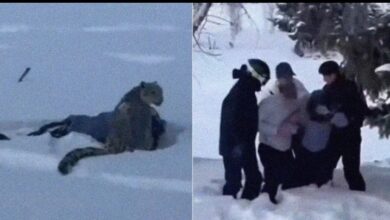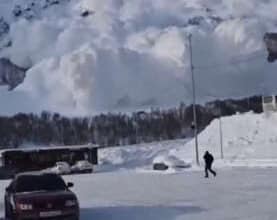

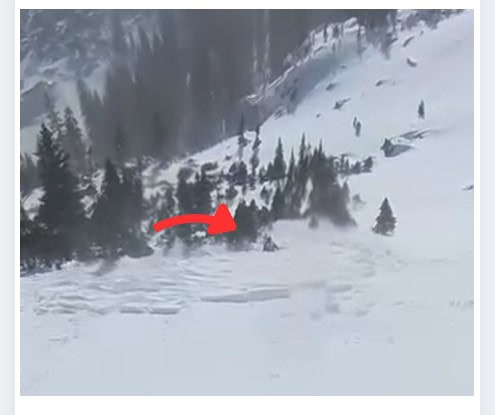
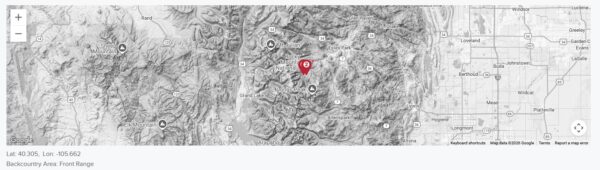
A human triggered avalanche involving a small group of snowboarders and a skier has drawn widespread attention after video of the incident circulated online over the weekend. The slide occurred on Saturday in Haiyaha Couloir in Rocky Mountain National Park, a narrow and consequential line that funnels directly toward Lake Haiyaha.
Footage shows one rider being carried downslope before managing to grab a tree and arrest his movement. He sustained a dislocated shoulder but remained on the surface and was not critically buried.
According to a detailed field report submitted to the Colorado Avalanche Information Center, the group entered the terrain with a plan to manage risk through ski cutting. However, conditions changed rapidly as they moved upward.
“We entered this terrain planning to ski cut. We saw cracking while booting to our objective, redirecting the path around slabby areas. We ski cut the upper chute. The wind slab we triggered cleared the upper chute and skier’s left of the lower run,” the CAIC accident summary states.
The report explains that the first rider stopped in an island of safety, while a second positioned lower on the slope. The third rider then entered a section of untouched snow with speed carried over from above.
“The 3rd leapfrogged, entering the untouched slope, with the speed from the upper chute. It cracked above him with an eight to 14 inch crown. It caught, carried, and briefly buried him. He grabbed a tree, dislocated his shoulder, and ended up on the surface,” the report continues.
As the group moved to assist, additional instability was triggered.
View this post on Instagram
“As the other two dropped to help, the upper skier triggered the remaining hangfire, which carried the lower rider. The slide stopped after 10 to 15 feet,” the CAIC summary notes.
Despite the severity of the incident, the group was able to manage the injury in the field and exit under their own power.
“Shoulder relocated, descended the rest of the way to Haiyaha, ascended Dream Ridge, and shredded out the dream chutes. Spirits were high, we were happy to be at the trailhead; a beer was drank, and we talked about our experience after.”
The CAIC publicly acknowledged the group for sharing both the video and the accompanying report, emphasising the importance of open reporting within the backcountry community.
“We all benefit when people share information about their incidents so that we can learn from them. Many factors contribute to avalanche accidents, and there are key takeaways we can all glean from reading these reports and studying those factors. We ALL make mistakes,” CAIC wrote.
The incident serves as a sharp reminder that even experienced groups, using recognised risk management techniques, can be caught out when wind slab conditions and terrain complexity intersect. The willingness to share mistakes openly may ultimately be the most valuable outcome of the day
images and text CAIC instagram