
Marmot Basin and Jasper are like conjoined twins, you cannot really talk about one without the other. Both sit within Jasper National Park, a short 25-minute drive apart, in a kind of symbiotic relationship where the town and the mountain keep each other vibrant. The connection runs so deep that if you say you are going skiing in Jasper, everyone knows exactly what you mean. In July 2024, that bond was tested in the most devastating way when wildfires swept through the region.
The fires forced the mass evacuation of around 25,000 residents, workers and visitors on July 22 and ultimately destroyed 359 of the town’s 1,113 structures. It took until September 7 for the wildfires to be contained after burning through 32,722 hectares of land, and they were not declared fully extinguished until April 2025.
In 2026 we were here to see how Jasper, like a phoenix rising from the flames, is finding its way back. The quaint town itself was relatively untouched, yet whole pockets of the village are missing, mostly housing, and construction crews are busy everywhere you look. But step back and take in the valley and the scale of the devastation becomes clear. The mountainsides are covered in solitary blackened trunks, which from a distance look eerily like dark, thinning hair spread across the slopes.
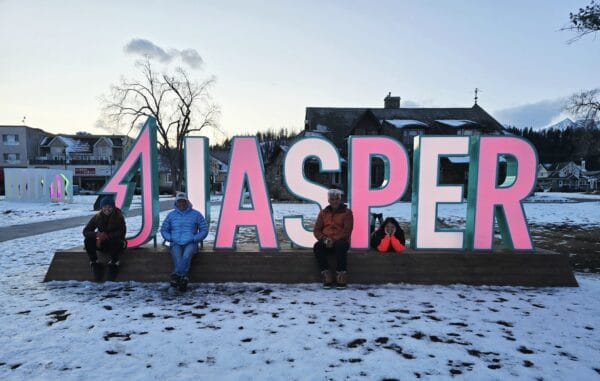
Jasper sits at the heart of Jasper National Park, a stunningly beautiful park and the largest national park in the Canadian Rockies, covering more than 11,000 square kilometres. Located in northern Alberta, far from Calgary or Edmonton, its remoteness is part of what makes it special. Unlike many resort towns, Jasper has avoided overdevelopment. The village remains compact and walkable, with streets lined by low wooden buildings and cafés rather than sprawling commercial centres. Here, the mountains, glaciers, rivers, and forests are the focus.
The town has a long history, first established as a fur trading outpost in the early 1800’s then a railway hub built in the early 20th century, bringing more people to the region, later gaining recognition for the surrounding natural wonders. Indigenous peoples lived in the area for thousands of years and their connection to the land is evident in place names, trails, and the careful way the park is managed. Wildlife was abundant when we had previously visited Jasper, before the fires; elk, moose, and bighorn sheep roamed freely, but this time we didn’t see any, not sure if this is due to the wild fires or whether we didn’t look hard enough. Local stories also hint at Sasquatch sightings near Pyramid Lake or along the Icefields Parkway. Fact or legend, they remind you how wild the region still is.
As you drive the 25 minutes from Jasper to Marmot Basin, the winding road edged with snow feels sombre, the scars of the fire visible on every mountainside. Blackened trunks, stand where dense forest once grew. Yet by some blessing of the ski gods, whether a shift in the wind or a fortunate break in the trees, Marmot Basin itself was spared any fire damage. It feels almost surreal, as though you drive out of the carnage and suddenly arrive on an ethereal white plain surrounded by mountains.
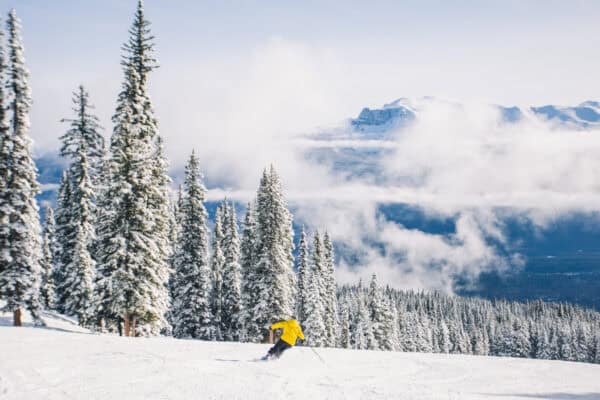
Marmot Basin, as the name suggests, sits within a vast natural bowl. The mountain forms a broad V shape, and you arrive at the apex where the base area hums with activity. Here you’ll find ski hire, a ski shop, cafés and restaurants, and from this hub the lifts spread outwards, opening access to some of the most stunning terrain in Alberta.
What is now known as Marmot Basin ski area was first identified by Swiss guide, Joe Weiss with initial trails developed in the 1930’s. The first ski lift (or tow rope) was installed in 1961 and by 1964 Marmot Basin Ski Lifts Ltd was issued their license to operate and since then it has continued to grow into what we see today.
What stands out immediately at Marmot Basin is the way the terrain caters to everyone. The mountain spreads across 1,675 vertical metres, with 91 named runs served by four lifts, yet the way the slopes are laid out makes it easy to navigate regardless of ability. Families and beginners have access to gentle cruisers from the lower and mid lifts as wide green runs allow confidence to build gradually. There’s also long blue and black runs that wind through natural glades and rolling terrain, providing variety without ever feeling intimidating. Most of the runs naturally funnel back to the lift hubs, making it simple for groups of mixed ability to ski at different paces and still meet up.
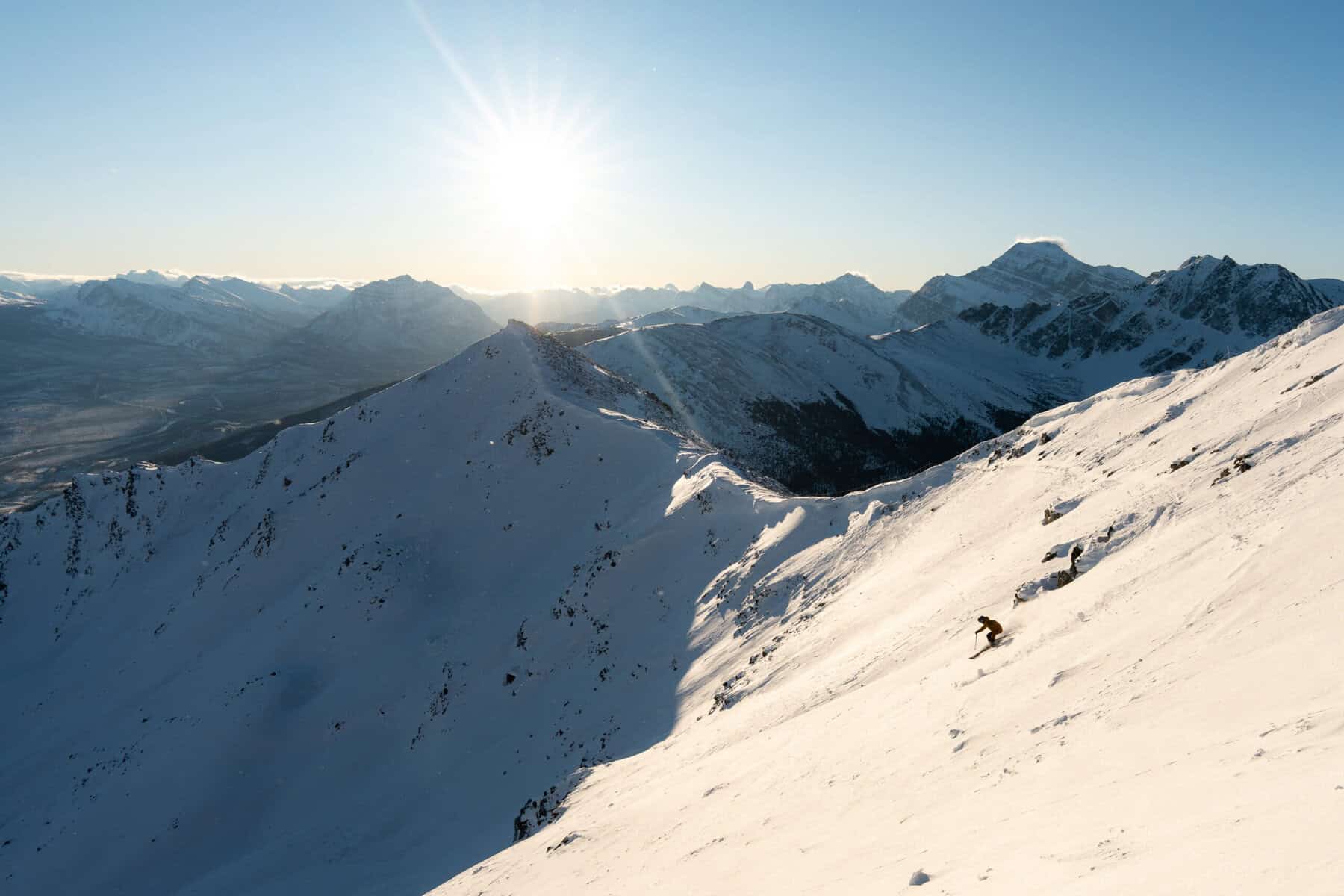
We were impressed with the terrain available for advanced skiers with plenty of variety to challenge them, particularly off the Knob Chair. This provides access to the recently opened vast alpine area known as Marmot Cirque. From here, you can drop into some of Alberta’s best expert terrain, with steep chutes and ridges leading into wide open bowls. We were lucky to be there on a clear day after fresh snowfall, and it was impressive to watch as skiers and boarders dropped into lines through untouched powder. In addition, numerous double black runs are accessible from the top of Eagle Ridge and the Paradise Chair, offering plenty of demanding terrain for experienced skiers.
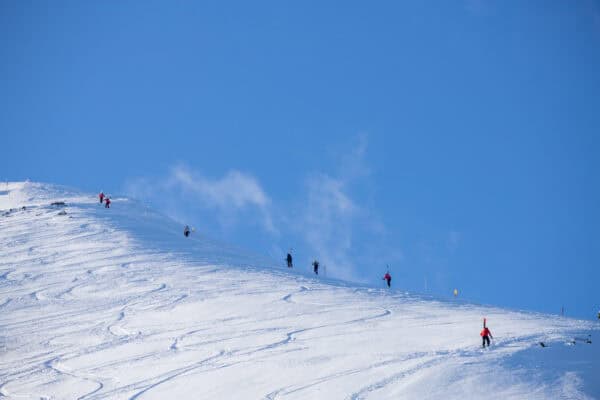
It is worth going up to the top of the mountain, simply for the views. From mid mountain and above you can see across Jasper National Park, the Athabasca River winding through the valley, and jagged peaks rising in every direction, giving a sense of the scale of the Rockies that you rarely get from a ski lift.
Snow conditions here can transform the mountain completely. During our last two days, fresh powder fell, filling bowls, softening glades, and refreshing groomed runs. Beginners could navigate soft slopes safely, intermediates could explore wider lines and tree runs with confidence, and experts could drop into steep chutes or traverse off-ridge lines to find untouched snow. Marmot’s combination of vertical, varied terrain, and reliable snow means that no matter your level, there’s always a line to suit you, and on fresh-snow days, it feels like the mountain has expanded, offering endless options.
All of this terrain is supported by a full suite of mountain services, from well-run ski schools to rental shops and knowledgeable patrollers who keep the slopes safe.
This careful balance between access, service, and wilderness character carries over into the town itself. Jasper’s isolation and careful stewardship mean that even in peak winter, the slopes and village rarely feel crowded. The mountains feel expansive, the forests intact, and there is a quiet between runs that is almost tangible. At the same time, the town provides what skiers need: restaurants, cafes, gear shops, souvenirs and comfortable lodges. It is this combination of accessibility, untamed nature, and local character that makes Jasper unique; a place where skiing is as much about the landscape as the runs themselves.
Parks Canada Entry Fee: As Marmot Basin is located in a National Park, a Parks Canada entry fee is required for each person. If travelling with a group it is better to buy a family pass, it cost 4 of us CAD$122 for 5 days in the park.
Mountain Access: A daily ski shuttle will run between the town of Jasper and Marmot Basin. Stopping at hotels in town, as well as at the Pentecostal Church and Marmot Meadows, we’re making it easier than ever to join us on the mountain! Tickets are $10 (return and one-way, all ages), and can be purchased online at sundogtours.com.
Kids Ski Free: Monday to Friday, all kids 12 and under ski and ride FREE! Available with no blackouts, including spring break!
Accommodation: Despite Jasper losing a large amount of its accommodation in the wildfires, most of these were local homes. As it’s in a National Park, to be a home owner you must work or reside in the National Park meaning there are no Air BnB’s in the park. So most of the accommodation is in the form of hotels and lodges, of which there are plenty. We stayed at the Jasper Inn and Suites, located at the northern end of town where a lot of the larger accommodation is located. It was perfectly positioned to allow us easy access to the bars, restaurants and shops. It also boasts a great pool, hot tub and two saunas, perfect for after a day up the mountain.
Find out more: www.skimarmot.com
- Mountain Facts:
1,720 acres (696 hectares) of terrain on five mountain faces
Highest base elevation of any major ski area in Canada at 1,698 m
Longest run 5.6 km
7 lifts including 4 quad chairs, 1 triple chair, 1 double chair and a Magic Carpet
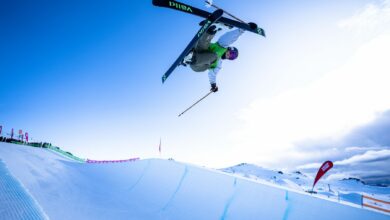
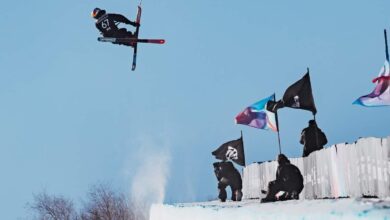
2 terrain parks across the mountain: Small to XL features: jumps, rails, boxes and jibs
Mini Terrain Park with small and medium features: rails and boxes
Skiing through 6 months from mid-November to early May
Averaging over 440 cms of dry, light Alberta powder snow annually